Map & Globe Skills
The ability to properly read maps and globes gives you an opportunity to explore different places, people, and cultures in the real world. These resources, teaching tips, and ideas will help make it easy for your children to learn to read and understand maps and globes.
Activities & Experiments

Name That Country Game
"Dear Pen Pal, Konnichi wa! We've been to see Mt. Fuji. Name my country! Sayonara, Michiko." Challenge your group with this fast-paced geography game, created in 1992 by Educational Insights, Inc. Everyone begins at the post office. Players twirl a finely printed spinner (built into the game board itself) to select one of 60 countries. If the player can correctly identify the country's location on the board's numbered map, he or she may advance along the path to the finish. Bonus moves are won by landing on "postcard" spaces, listening to the clues on one of the 40 postcards, and correctly identifying the pen pal's country. (The sample postcard above came from Japan.) A more challenging game can be achieved by requiring players to name the country's capital; answers are provided. --Liane Thomas
Postcard Kids
Geography Postcard Kids Project started for homeschooled children around the world in October of 2002. It is intended to help enhance geographic studies by sending postcards from their local area to other postcard kids around the world.

Great States Board Game
What is the capital of NJ? Where is the Football Hall of Fame? These are just a few of the hundreds of questions players are asked as they adventure around the USA discovering state attractions and landmarks, capitals, state abbreviations, state locations and more. In order to answer the questions on the cards, players must look closely at the colorful USA map game board, becoming familiar with the geography of the country. Players must hurry to find the answers as the mechanical timer ticks. Contents: Game board, 100 Figure cards, 100 Fact cards, 100 Find cards, 1 spinner, 1 mechanical timer, and game rules. Duration of Play: 20 minutes. 2-6 players.
Teaching Tips & Ideas
How I Teach a Large Family in a Relaxed, Classical Way: History
A look at teaching history across several grades using the classical method of education and a rotation of history every four years.
Knowledge Quest
Knowledge Quest offers historical outline maps and timelines designed for the interactive study of world history and geography.
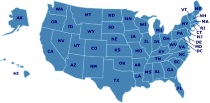
Looking for Another State?
Featured Resources
As an Amazon Associate, we earn from qualifying purchases. We get commissions for purchases made through links on this site.

The Teenage Liberation Handbook: How to Quit School and Get a Real Life and Education
This classic homeschool resource is intended for teens who are ready to take charge of their own education. Written by Grace Llewellyn in the '90s, it is still relevant today. Teens will be empowered by claiming their natural ability to teach themselves and to fully personalize their education. Covers the decision to leave school, as well as many of the learning opportunities available to teens.
Learning Language Arts Through Literature
Learning Language Arts Through Literature is a fully integrated language arts program that teaches grammar, reading, spelling, vocabulary, writing mechanics, creative writing, thinking skills and more.

So You're Thinking About Homeschooling: Fifteen Families Show How You Can Do It
Confused and intimidated by the complexities of homeschooling, many sincere parents never get past the "thinking about it" stage. Now Lisa Whelchel - herself a homeschooling mother of three - introduces fifteen real families and shows how they overcome the challenges of their unique homeschooling situations. This nuts-and-bolts approach deals with common questions of time management, teaching weaknesses, and outside responsibilities, as well as children's age variations, social and sports invol...

Homeschooling Essentials: A Practical Guide to Getting Started
If you're ready to begin homeschooling, then the experiences of others can offer valuable help and encouragement as you jump into this new adventure. This practical guide answers common questions, helps you navigate the legalities of homeschooling, talks about the practical side of homeschooling and different methods, offers resources and gives advice about high school.
Explode The Code
Explode The Code provides a sequential, systematic approach to phonics in which students blend sounds to build vocabulary and read words, phrases, sentences, and stories. Frequent review of previously learned concepts helps increase retention. Each workbook in this series contains exercises that incorporate reading, writing, matching and copying. The consistent format of the books helps facilitate independent work. This series includes primers—Get Ready for The Code, Get Set for The Code, and Go...